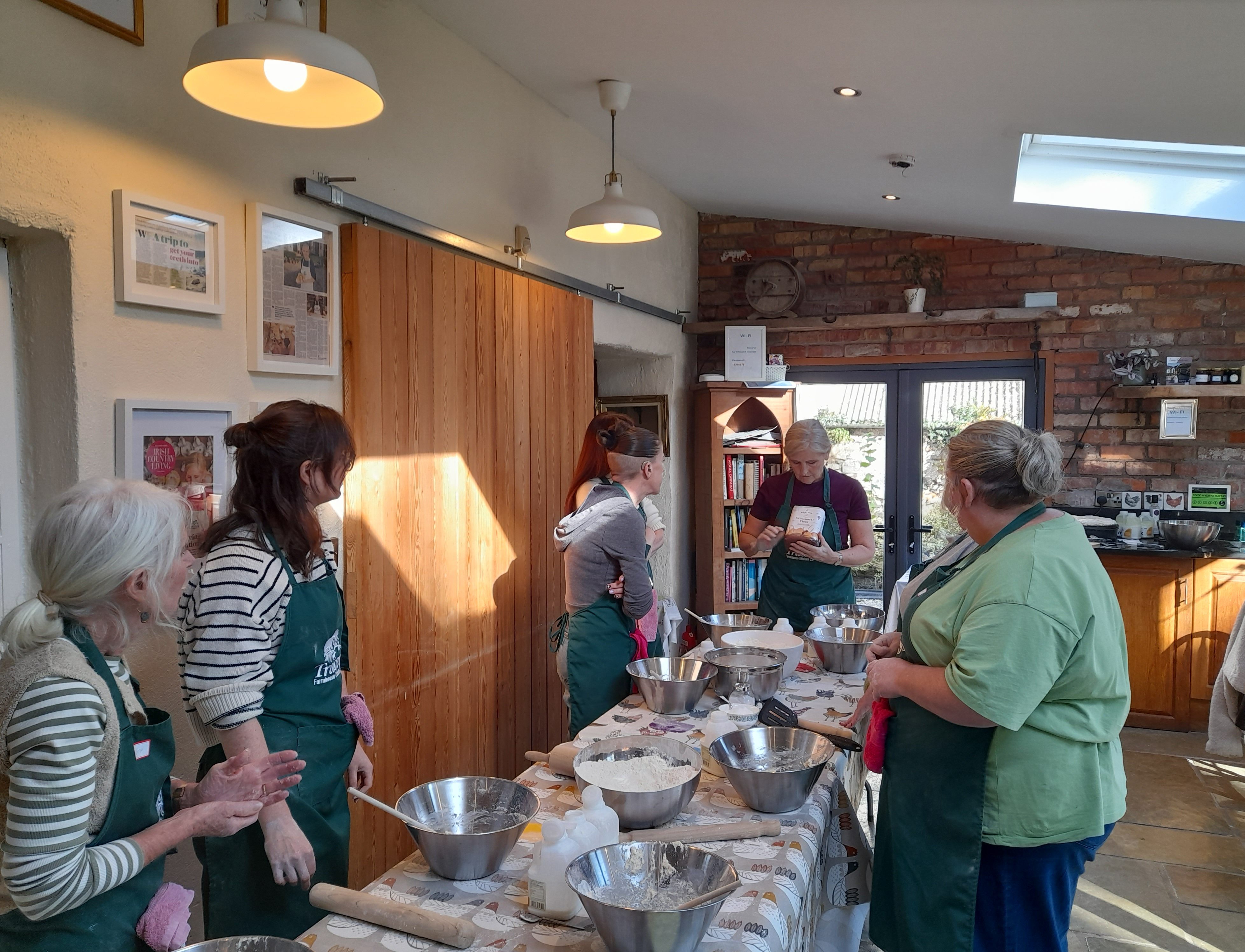
On a bright weekend morning, I learnt how to bake some traditional Ulster breads: soda, wheaten and potato bread. I’ve wanted to do this for some time and when online recently, I discovered Tracey’s Farmhouse Kitchen. Use the link to visit Tracey’s website, which includes much more than bread making.
My hands were covered in flour but I did manage to take a couple of photos of what turned out to be a very relaxing and enjoyable time. Tracey put us all at our ease and her instructions were easy to follow, and along with her small team of helpers, we made plenty of fresh bread to take home. Marvelous! 😋😋😋
Tracey’s straightforward instructions and the friendly atmosphere gave us all confidence.
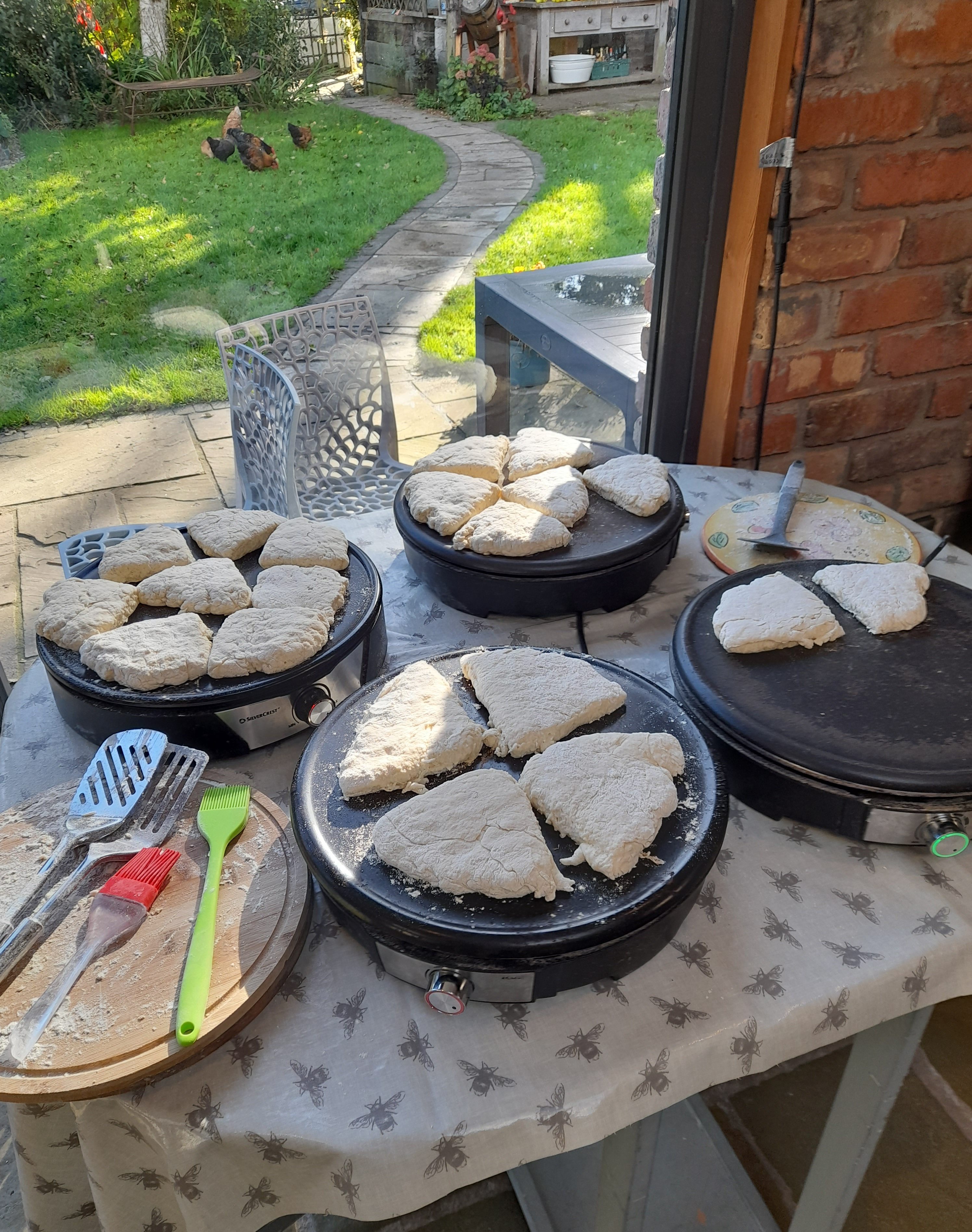
In the old days bread would have been baked on a griddle but these crepe hotplates worked perfectly.
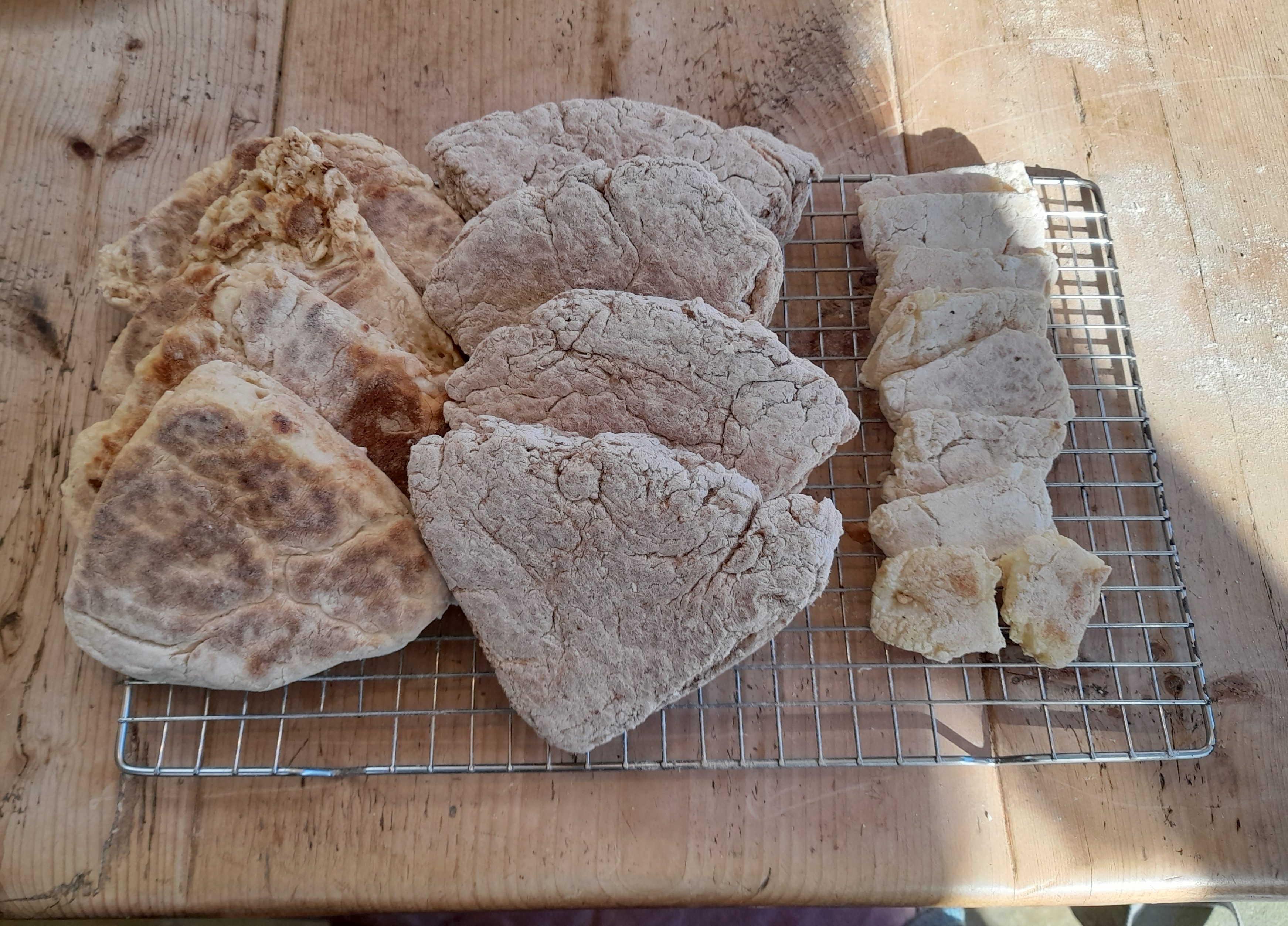
Not bad for a few hours work and ready to take home.
The farmhouse is situated right on the shores of Strangford Lough in County Down and whilst there the sun shone, making my visit to the area especially inviting. The countryside and shorelines there are beautiful with lots of places to visit and things to do.
As I now follow the seasonal tree cycle suggested in The Ogham Grove* the common Elder, Sambucus nigra, is seen as the guardian of the West and Dusk, and as it falls into the period between the 12th and the 29th September, it is the tree of the Autumn Equinox. It is the 15th letter in the tree year: RUIS – R in Old Gaelic.
In Mandy Haggith’s wonderful anthology of tree poems Into The Forest* she opens the chapter on the elder tree describing it as more like a “scraggy shrub!” I love that expression! The elder tree is rarely seen as a full grown tree and is more usually found in hedgerows, or anywhere there is or was human habitation, where a phosphate rich soil is to be found (bones from domestic rubbish heaps or burial grounds). The wood of the tree has been used for small items such as pipes and whistles as the narrower branches have a soft core which can be hollowed out. The main areas of use though have been the medicinal properties garnered from the flowers in spring and the berries in autumn when cures for anti-inflammatory or anti-viral ailments are required.
It was said that having an elder tree growing near your home would protect it from evil. The leaves have a distinct smell, not a pleasant one, and small bunches would be hung in dairies and kitchens to keep flies away; sprigs of leaves would also be attached to horses bridles.
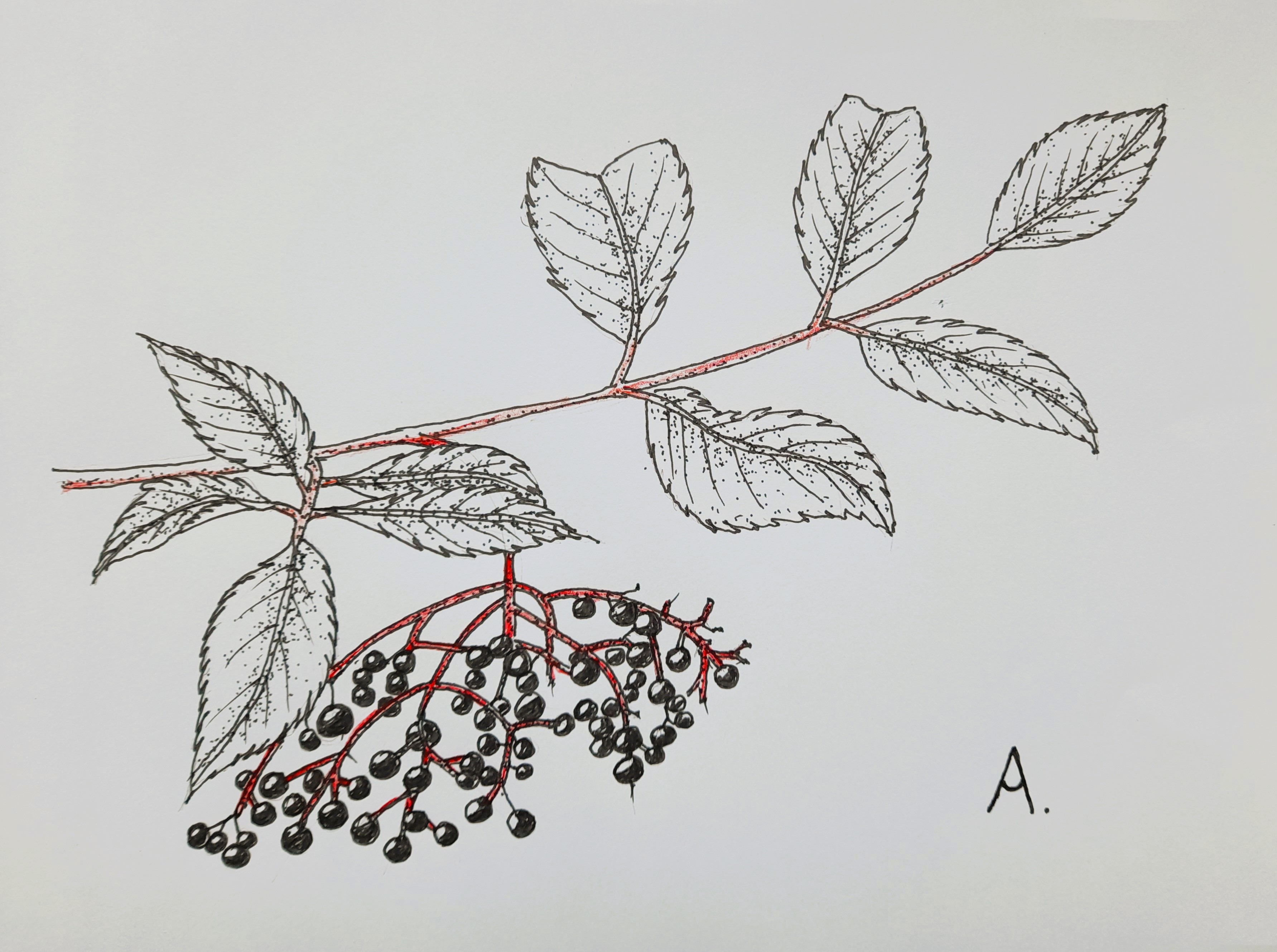
A sketch by myself after one by Lizzie Harper.*
Here is part of a poem that I wrote last year:
In autumn
..............berries like alien antennae,
hang;
shining, black, full of vigour,
they shiver on the air.
Ashley 🌳
*The Ogham Grove by Yuri Leitch – ISBN: 9781517653637
*Into the Forest: An Anthology of Tree Poems – edited by Mandy Haggith – ISBN: 978-190864318-6
*The Living Wisdom of Trees by Fred Hageneder with illustrations by Lizzie Harper – ISBN: 978-1-786783-33-2
Further reading: The Tree Dispensary: The uses, history and herbalism of native European trees by Christina Stapley – ISBN:978-1-91350-472-4
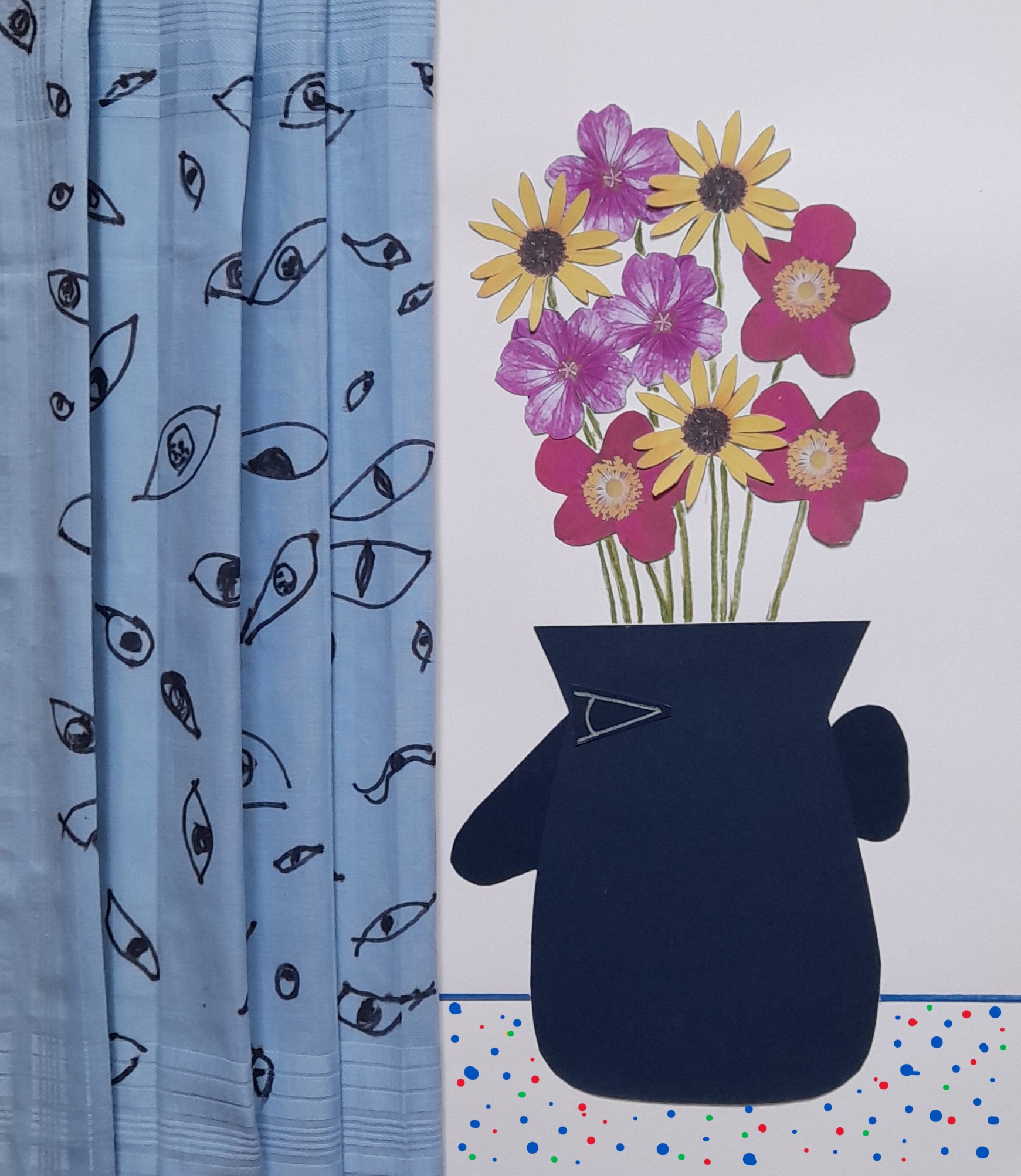
There is so much to learn and so little space in a busy schedule this year. I knew nothing about the artist Odilon Redon and when I looked his work up I was presented with so many images of flowers, vases, heads and eyes. Surprisingly, I was able to complete this K-A very quickly; it is a collage of cardboard images of the flowers currently blooming in our little garden. I even managed to sign it!
Here is the link to Phil Gomm’s Kick-About website where you can see the amazing creativity of the other artists:
Already it’s August and Lammas is upon us; a time when we celebrate the summer and the gathering in of the harvest. There’s work to be done as the wheel of the year turns towards the Autumn Equinox and the darker days of winter.
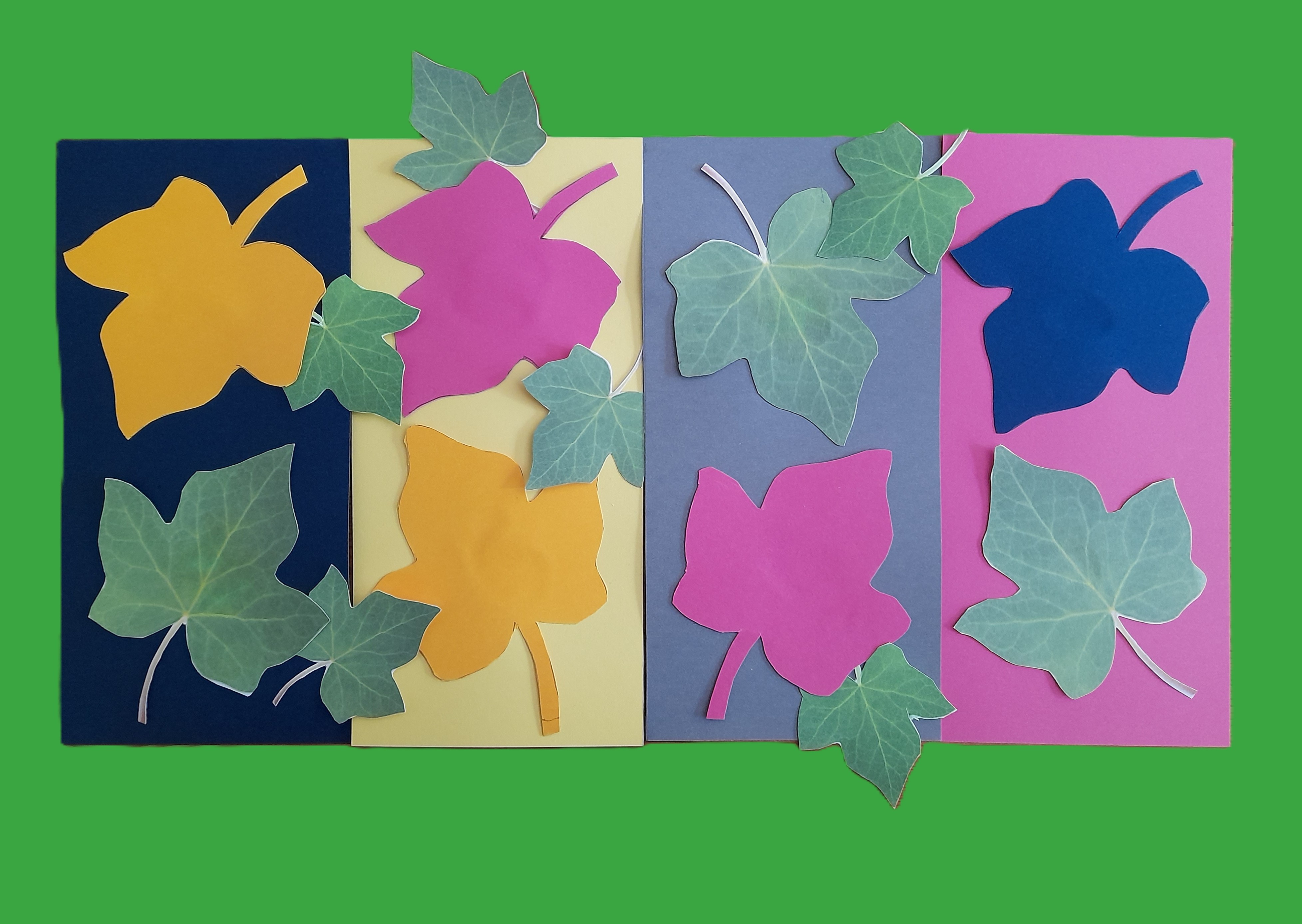
Ivy, Gort in Irish, is the 12th letter (G) in the Ogham Tree Year. As Yuri Leitch says in his book The Ogham Grove, Ivy is an evergreen and is seen symbolically, as immortal; of the spirit world.
Ivy, Hedera helix, is not actually a tree, but a climber belonging to the Aralia family, Araliaceae. A slow grower it can live for hundreds of years. Its fruits are nutritious to birds like blackbirds and thrushes but they are poisonous to humans if ingested: the berries contain Triterpenoid Saponins and Oxalate Crystals. The leaves were collected as fodder for livestock from ancient times up until the 16th century.
In ancient Egypt, Ivy was dedicated to Osiris, the lord of vegetation. Along with the vine, it was concocted to use in ceremonies to honour the Greek vegetation god Dionysos, called Bacchus by the Romans.
A tough wood, it has been used to make tool handles.
Ashley
Books I’ve used as references:
The Ogham Grove by Yuri Leitch ISBN 9781517653637
The Spirit of Trees by Fred Hageneder ISBN 0-86315-557-X
Today, I should be celebrating the Summer Solstice, the longest day in the northern hemisphere, but for this post, I decided to draw something in memory of one of my favourite artists.
David Hockney (9th July 1937 – 11th June 2026)
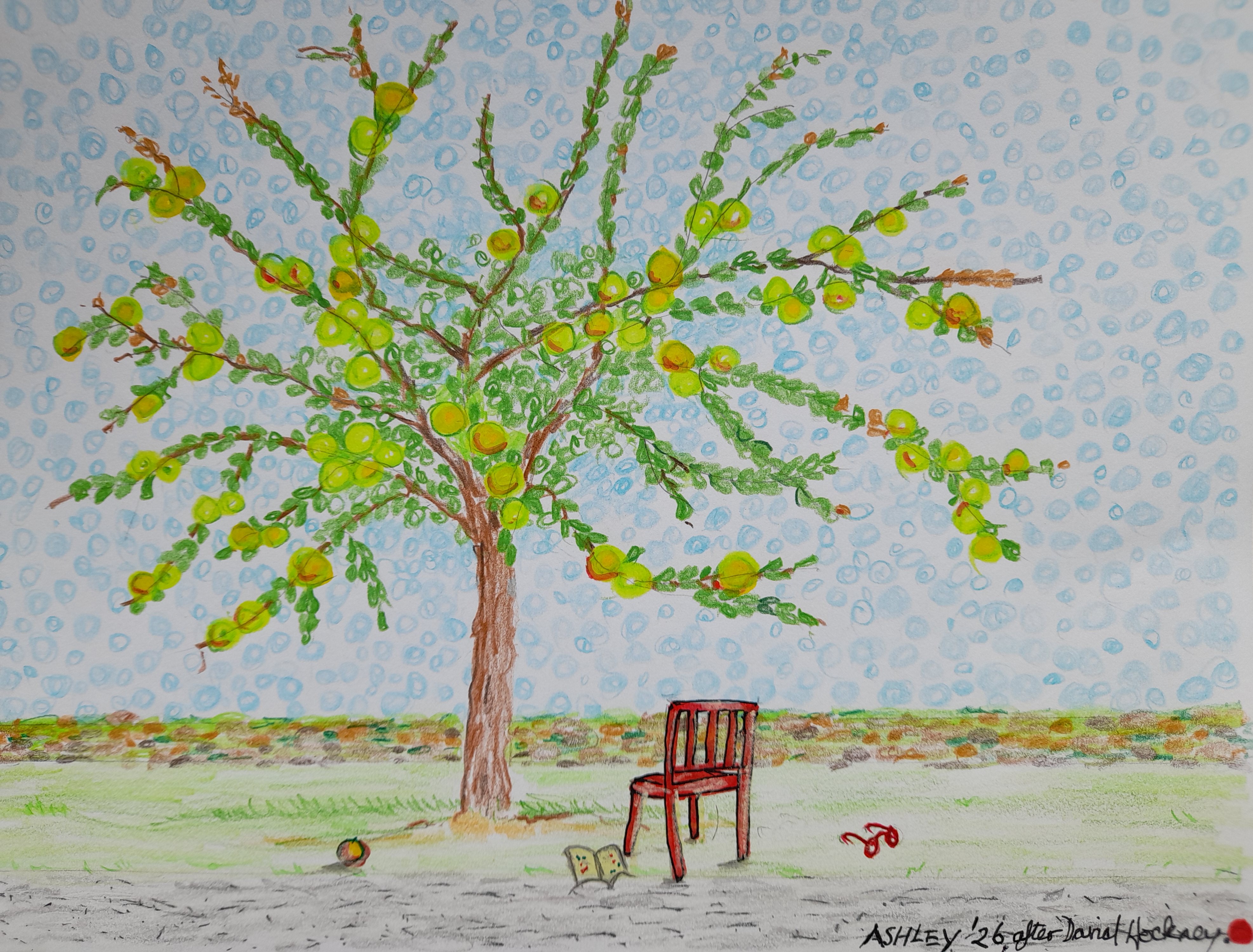
It is only a matter of weeks since his passing and my tribute is my version of one of his more recent paintings from his time spent in Normandy, France. I have loved his art since I first saw his work in the late 60’s and 70’s.
Here we are,
On the hill of summer;
The longest day.
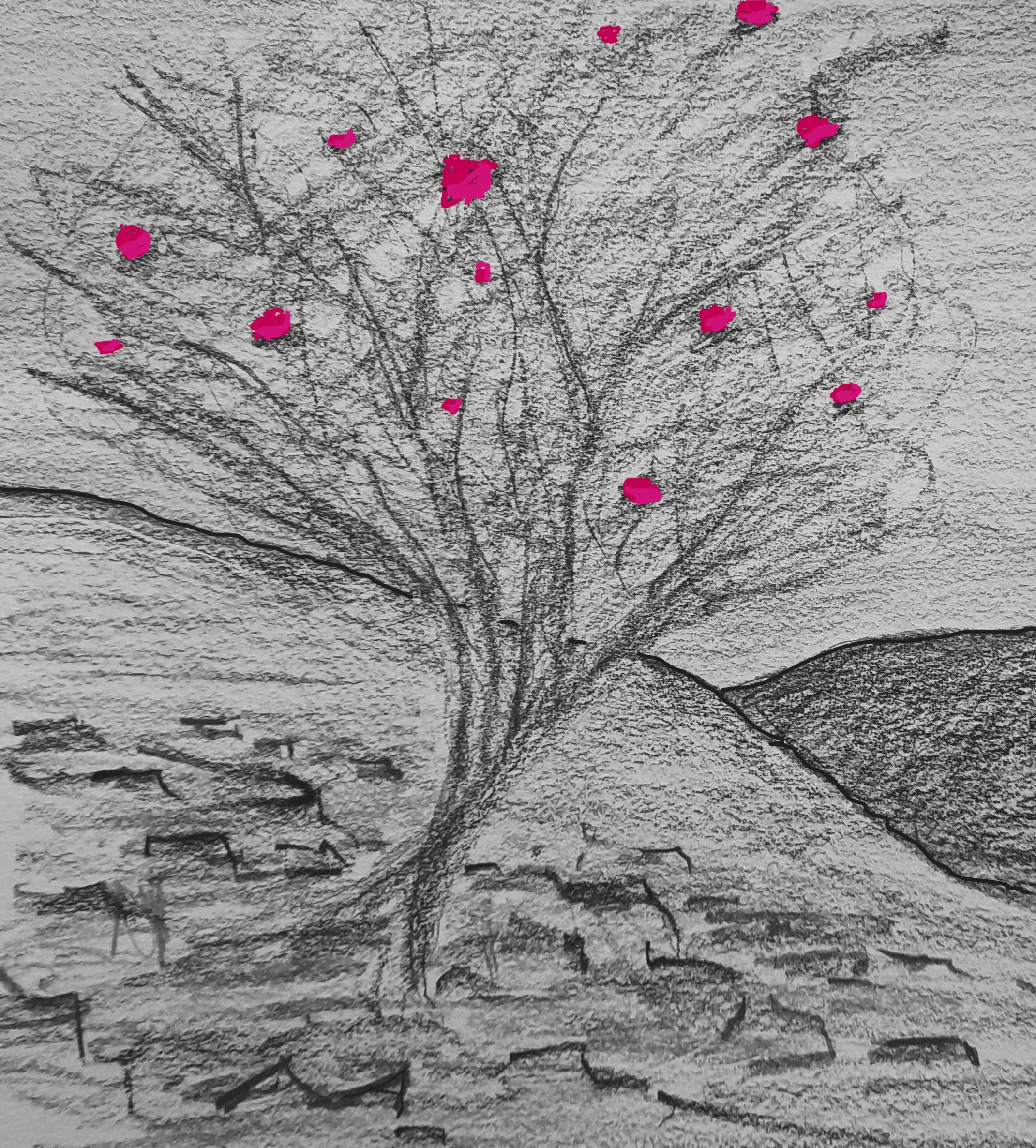
I chose this particular scene because it features an apple tree. Apple, in the Ogham Grove (*) is the guardian of the south, daylight and the summer solstice.
(*) The Ogham Grove by Yuri Leitch (ISBN 9781517653637)
Ashley
Here is a short video of the wonderful artist David Hockney:
This ancient festival of fertility and its manifestation in nature, literally growing under our feet, falls halfway between the spring equinox and the summer solstice. As with most things relating to the natural world, trees coming into leaf, flowers bursting into bloom or indeed the grass growing under our feet (I’m thankful that I no longer have a lawn to cut) I see this celebration as a period in time lasting for more than one day.
In honour of Mother Earth’s seasonal cycle, I choose to write and draw according to her timetable, hopefully, also living by her example. Unfortunately for this post, I struggled with my artwork. It lies unfinished in a folder ready to be refreshed and completed for next year, maybe! (As some of my regular followers already know, the last 6 months have been traumatic and unsettling, as my beloved recovers from major heart surgery. That journey for her has of course impacted my routines, especially regarding my own creative activity, so with small steps, mirroring her progress, I too recover).
So, a photo this time must suffice.
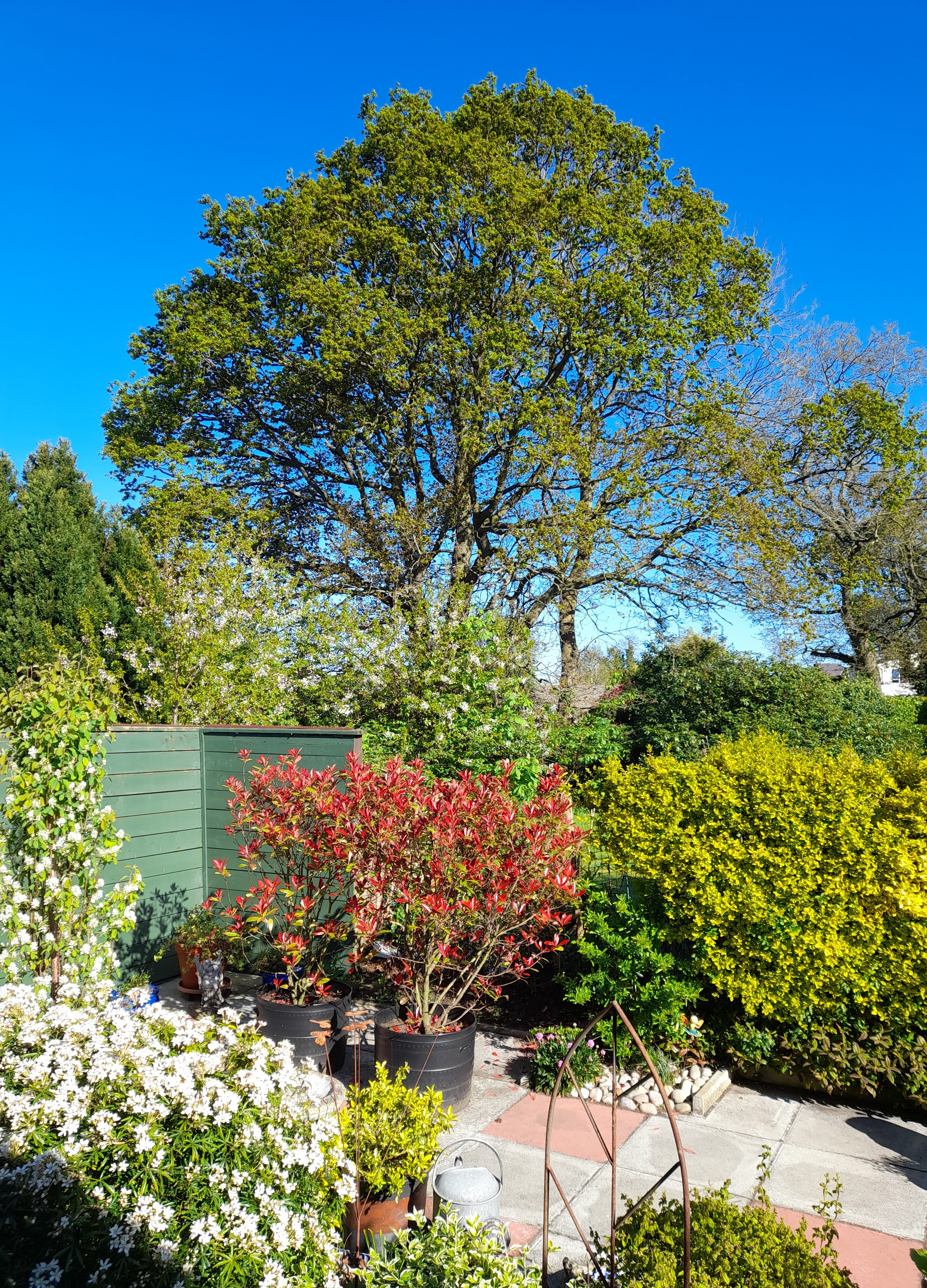
The oak tree in the photo is bursting with new leaves and soon I won’t be able to see the many branches. It is in a neighbour’s garden and I see this tree as being ready to embrace the light and warmth of the summer sun. Like most oaks in the UK she acts as a host to over 2300 different species who live on or within her being, from birds and squirrels to insects and fungi. Whilst sometimes referred to as being male I believe the oak tree embodies so much that is female, a mother indeed to so many new lives. I thank Brigitte on a recent Zoom meeting (The Ogham Grove)* for mentioning that she envisaged the shape of an oak tree as being similar to that of a womb. Wow!
With her branches held ready
for an embrace,
the oak tree.
A vessel, an ark,
welcoming all;
a doorway home.
The Oak tree is sacred to the Druids; in fact the word Druid means Oak Person. Also, the words for oak and door have ancient connections.
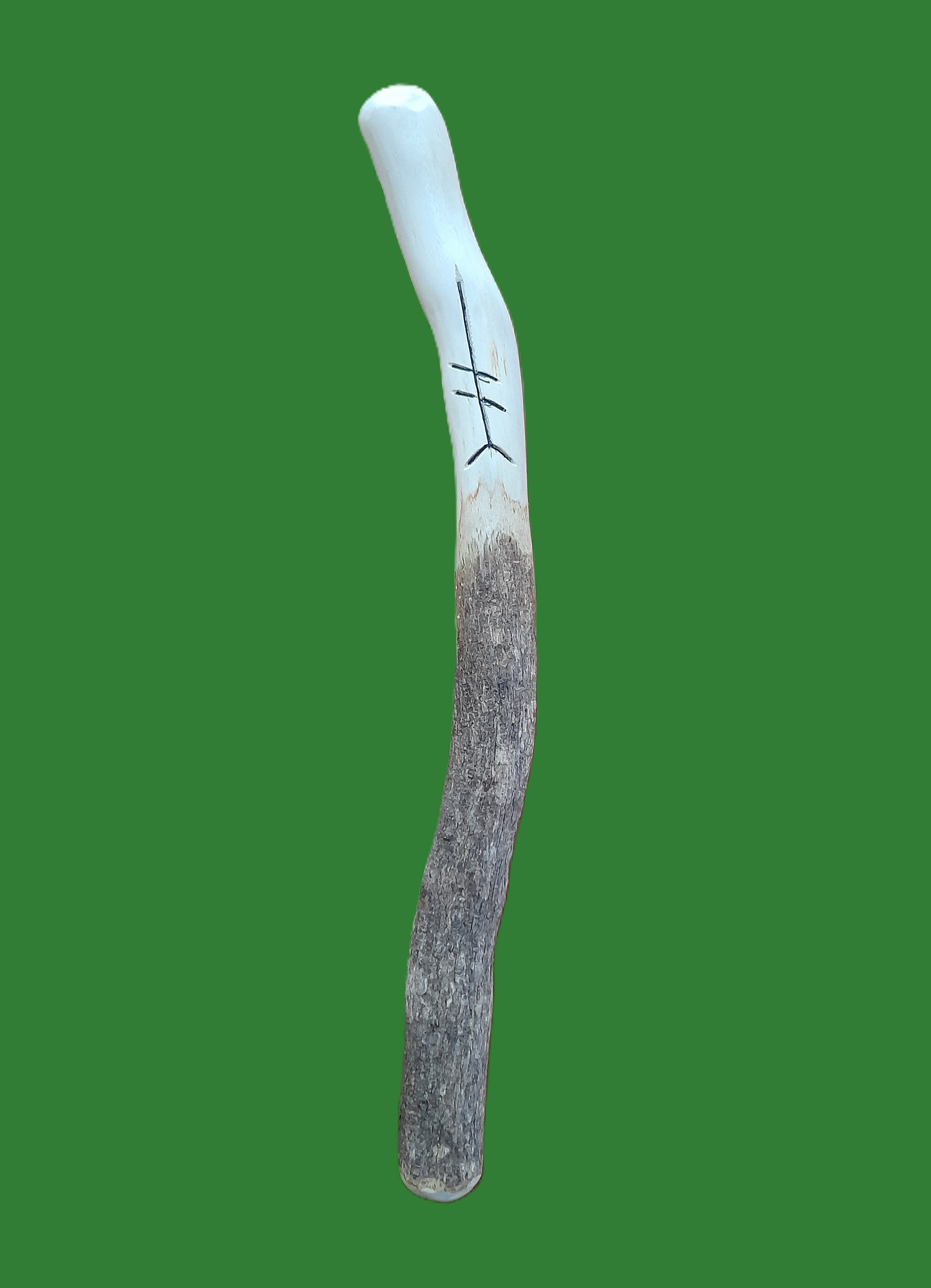
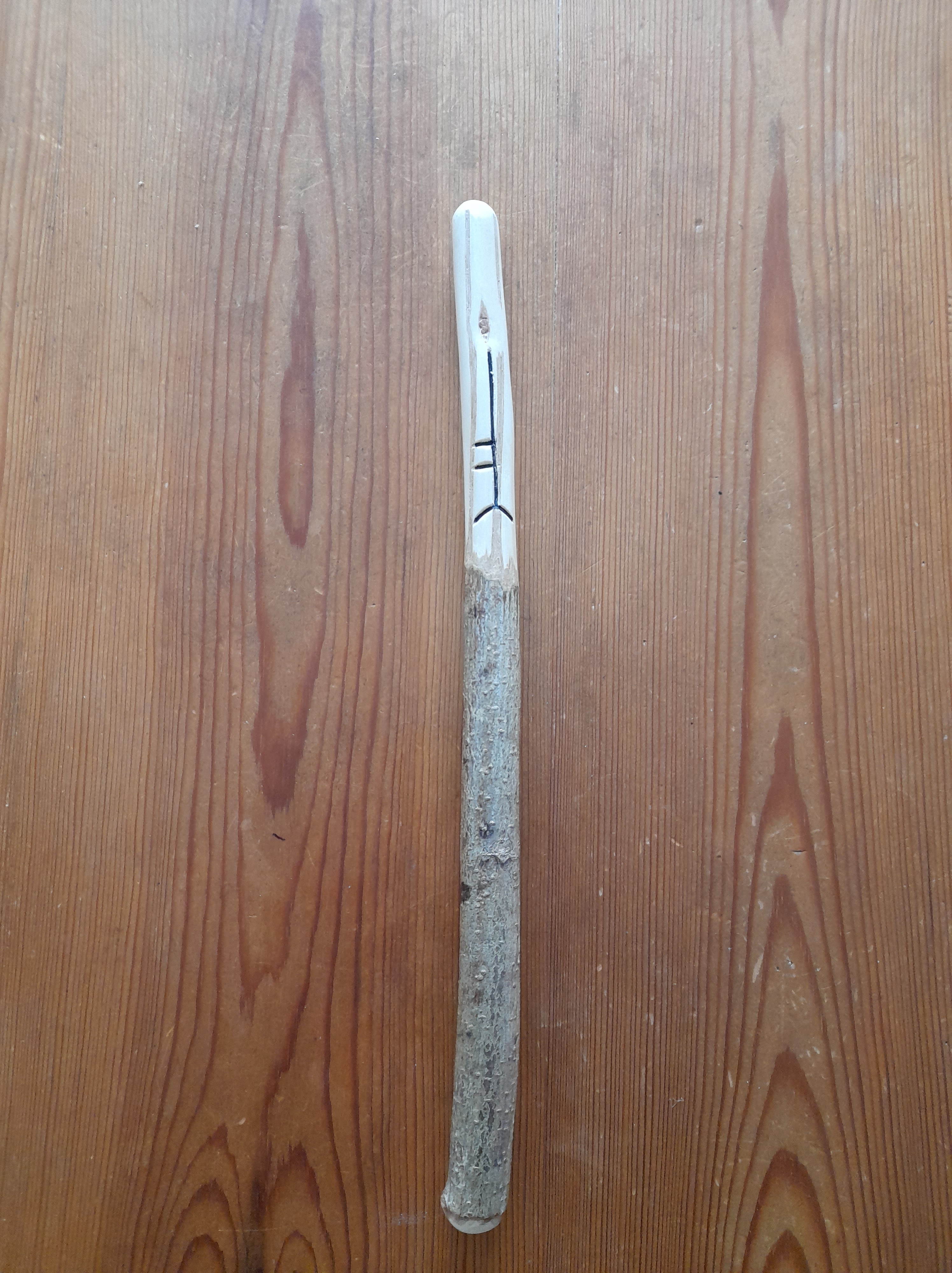
In the Celtic Tree Ogham the letter D (Duir) is represented by the symbol shown in the photo below. I whittled a piece of oak to show the symbol.
I will note at the end some of the books I refer to for my writing here. One that I am still reading is Galahad and the Grail;; a story told in ballad form, which I find irresistible! For now I should mention a new book that will be coming from the poet, singer and priest Malcolm Guite. The easiest way to do this is to include a short video from YouTube but here’s a taster of his words (I hope Malcolm will forgive me if I’ve got the line breaks wrong):
“…he knew each living oak is not itself alone // its roots reach out to other trees // a woven web of mysteries // from darkest soil to lightest breeze // embodying the memories of every year its grown…”
Thank you, Malcolm!
Here are the books that I look to for help:
Sacred Earth Celebrations by Glennie Kindred
The Ogham Grove by Yuri Leitch
Voices from the Grove by Yuri Leitch
*If you search on YouTube you will also find a series of videosmcalled The Ogham Grove*
For now, happy Beltaine to everyone who visits here.
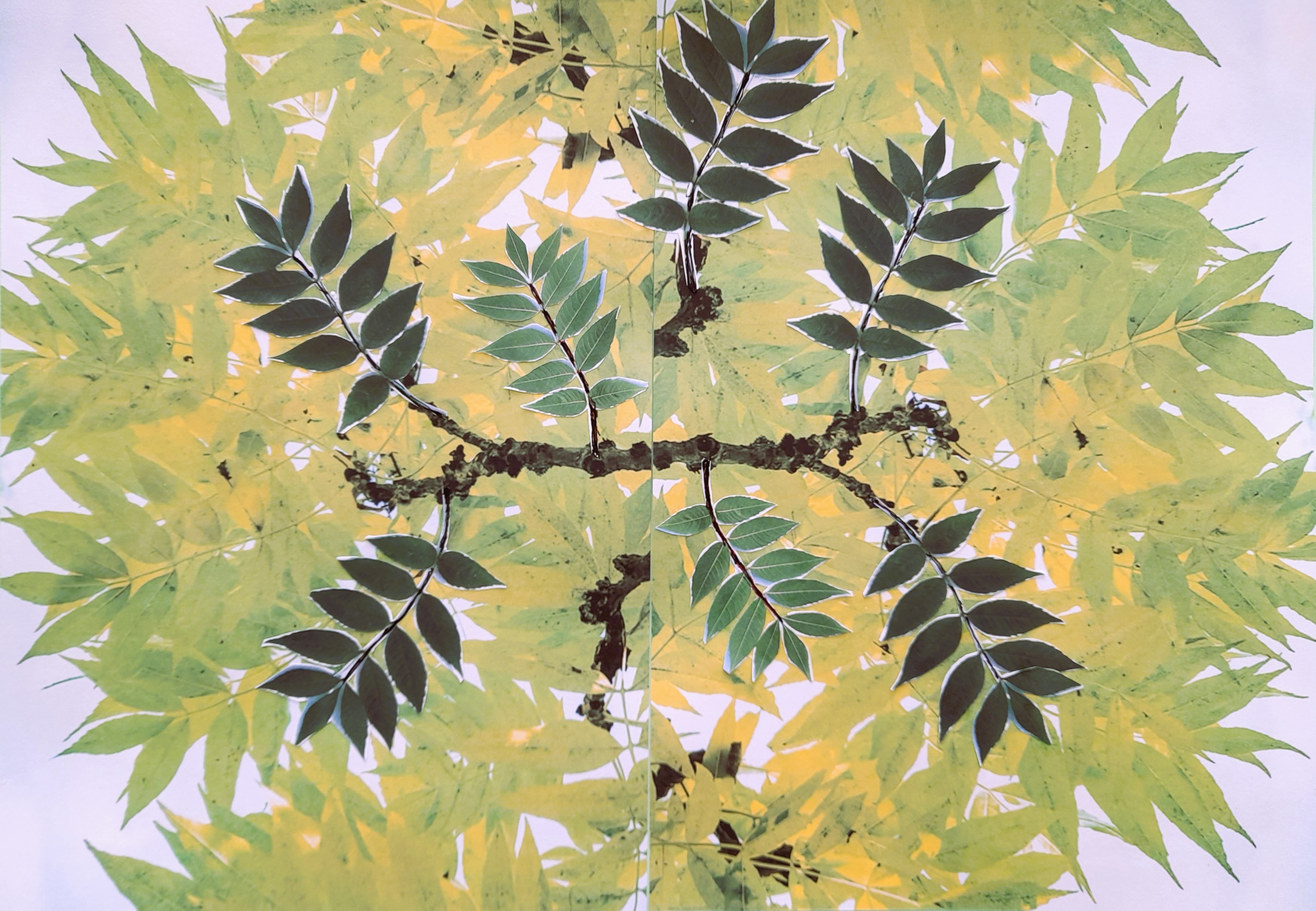
Beautiful ash trees (Fraxinus excelsior) whose timber is a tough hardwood with a straight grain and well used to absorbing shocks, but now under the threat of a disease, ash dieback (Hymenoseyphus fraxineus) a fungus, which may wipe it out. Under normal circumstances, the tree can live to the ripe old age of perhaps 400 years, but now its future is bleak. Can they survive?
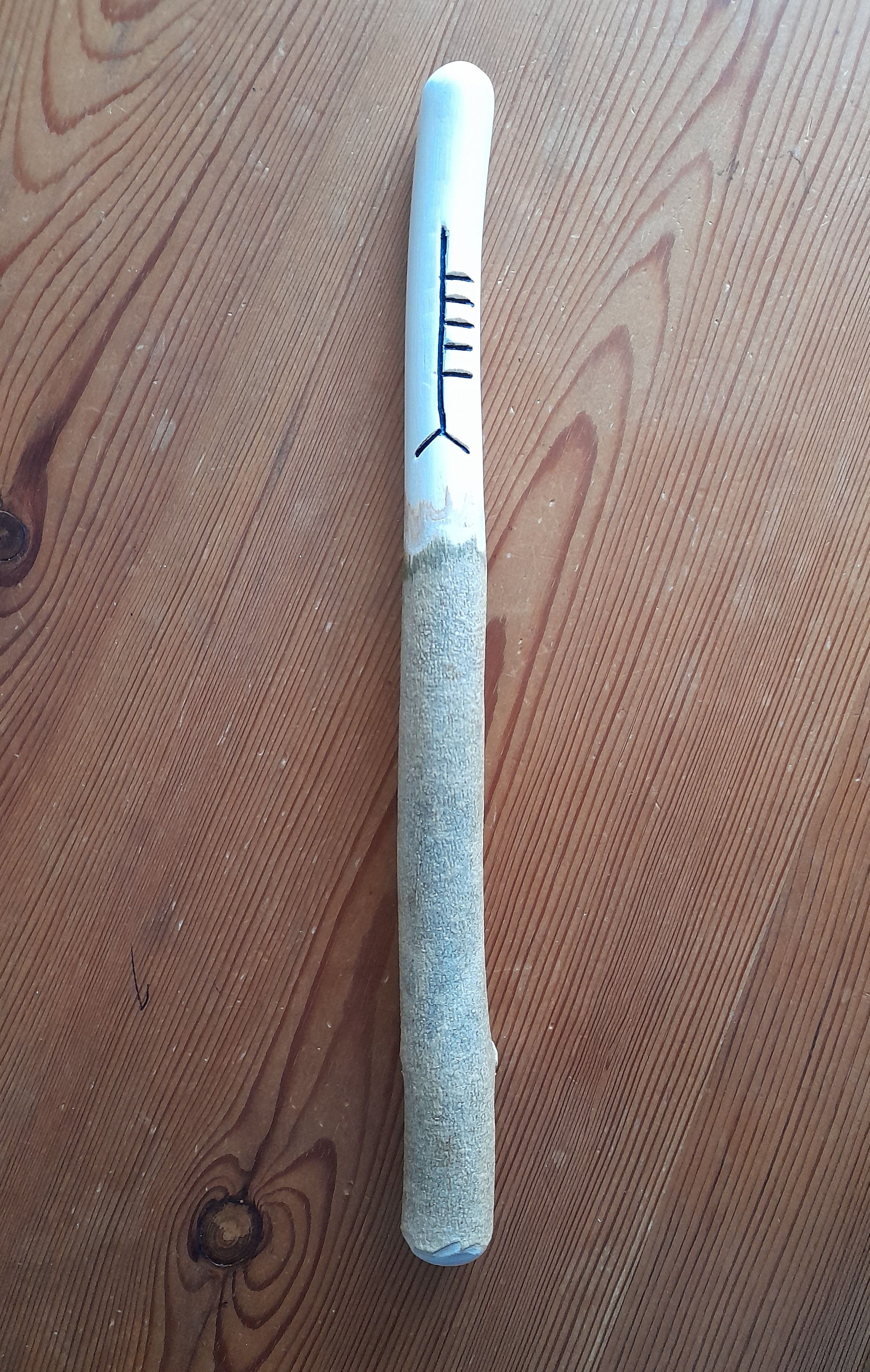
Typically, it has been used for making tools especially handles that absorb shock: hammers, axes, spades and oars. So useful, perhaps that’s why in mythology it has been referred to as the Tree of Life. It is the 5th tree in the Celtic Tree Ogham and below I include a photo of my own piece of ash with the ancient symbol for the tree.
Buds opening,
Bright, on this dull day;
The Spring Equinox.
From this day onward, the days will become longer and warmer.
I recently came across this wonderful album called Songs For The Trees by Kate Daisy Grant and Nick Pynn. In the notes to the album, Kate says “there needed to be songs written to honour and portray some of the innate powers, characters and stories of the trees, so they could be central characters themselves“. What a wonderful thought and one which I applaud.
With Kate’s permission I have included the track Od’s Song (For The Ash), the last lines of which are as follows:
The brightest of the noble trees
That reaches through the skies

Mighty tree you'll be my steed
As I wade through the river and rime
Through boiling waters with a scream
And a gift for all mankind
You will see what is not yet and back to early time
As above is so below; without is so inside
So drink up, revel in the cheer- the three worlds come to life
For the swing and the sway is the only way
To where all worlds collide.
Today should be a moment of celebration. And in many ways, it is. We celebrate the progress won by those who believed in safety and dignity for all, and the women who are leading countries and communities around the world.
But right now, that progress is under threat. Countries are facing a backlash against women’s rights. Around the world, women’s safety is in crisis; their voices silenced and their lives threatened. One in three women globally will experience physical or sexual violence.
Let’s make this International Women’s Day more than a day in history. Let’s protect what has been gained and keep pushing for progress.
I have copied the above from CARE International UK’ s newsletter received this morning and I will sign their open letter to forward to our UK government.
It’s February, and on the ancient pagan calendar, it is the beginning of spring. Whilst my first picture is from autumn last year, it is of a berried Rowan tree, and the Rowan or as it is sometimes called, the Mountain Ash, is featured in many myths and legends in Celtic and pagan stories. It has many other names: Witch Wiggin Tree; Wizard’s Tree; Rowanberry; Quickbeam.
True grit,
On a mountainside;
A Rowan tree.
The tree is tough and frost resistant and can grow on the lower slopes of mountains up to 1800 m / 5900 ft. It is light demanding, growing in the margins and clearings, and is tolerant of most soils. A good tree for small gardens too, as it won’t grow more than 15 m / 50 ft. With white spring flowers and orange / red berries in autumn, birds and insects love this tree. The tree also has many associations with lichens and fungi. The wood is easy to work and has been used to make small items such as spindles and stakes. Whilst it doesn’t grow to be a very old tree it is fast growing and allows other trees to establish. Known as a pioneer tree, it is tenacious, taking root even in inhospitable locations.
Rowan is the 2nd tree in the Celtic Tree Ogham. In Old Gaelic it was called Luis, pronounced LOO-sh, and is believed to signify the letter L. It is the sacred tree of Brigit or Brigid [ 1 ] who is celebrated on the 1st February, heralding the arrival of spring. A black 5 pointed star is conspicuous on the berries which is seen as a sacred mystical symbol, the pentagram, aligning with earth, air, fire, water and spirit. Wands of Rowan have been used to make protective magic circles or for summoning creative energy.
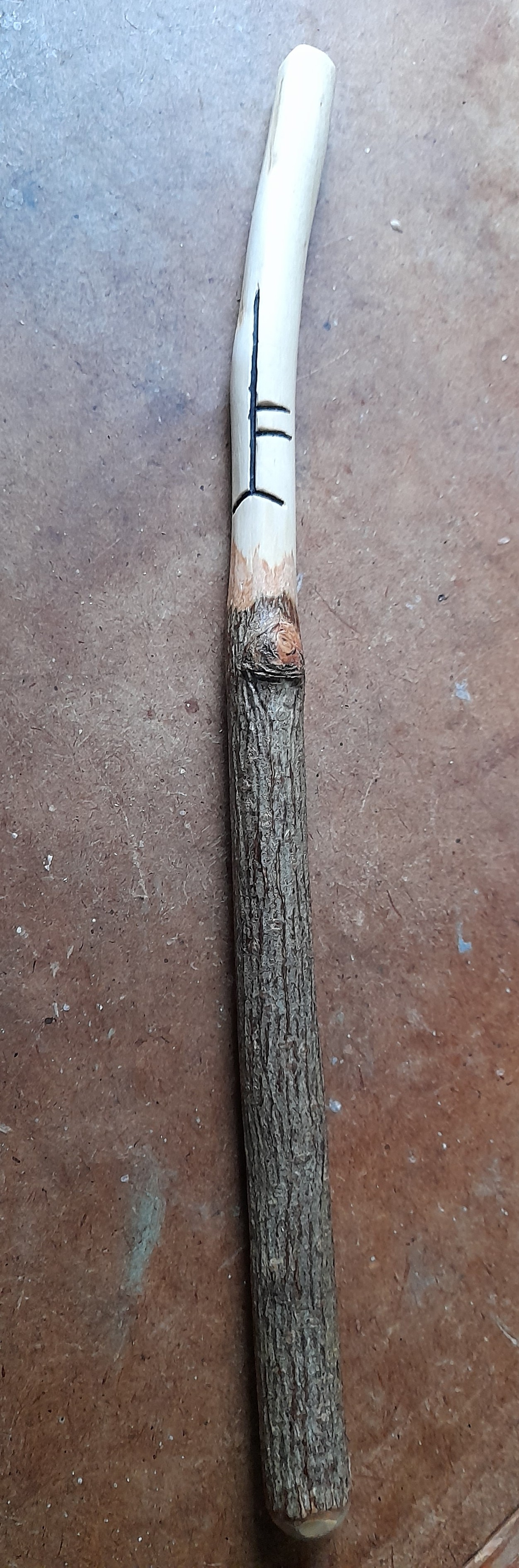
Below is a photo of the script for Rowan which I carved into a piece of Rowan wood:
Rowan
The Imbolc festival is the mid point between the Winter Solstice and the Spring Equinox and also celebrates creativity, divination and the traditions of the arts, especially poetry and song.  Brigid is in fact the patroness of healing, smithcraft and poetry, so, from Mandy Haggith's anthology (see below) I have selected a short piece from the poem Robin's Rowan [ 2 ] by Colin Will:

Your power, enchantress, is in your leafy shield;
A berried blessing, sanguine, steadfast.
Stand so for us, for all your green hands shade.
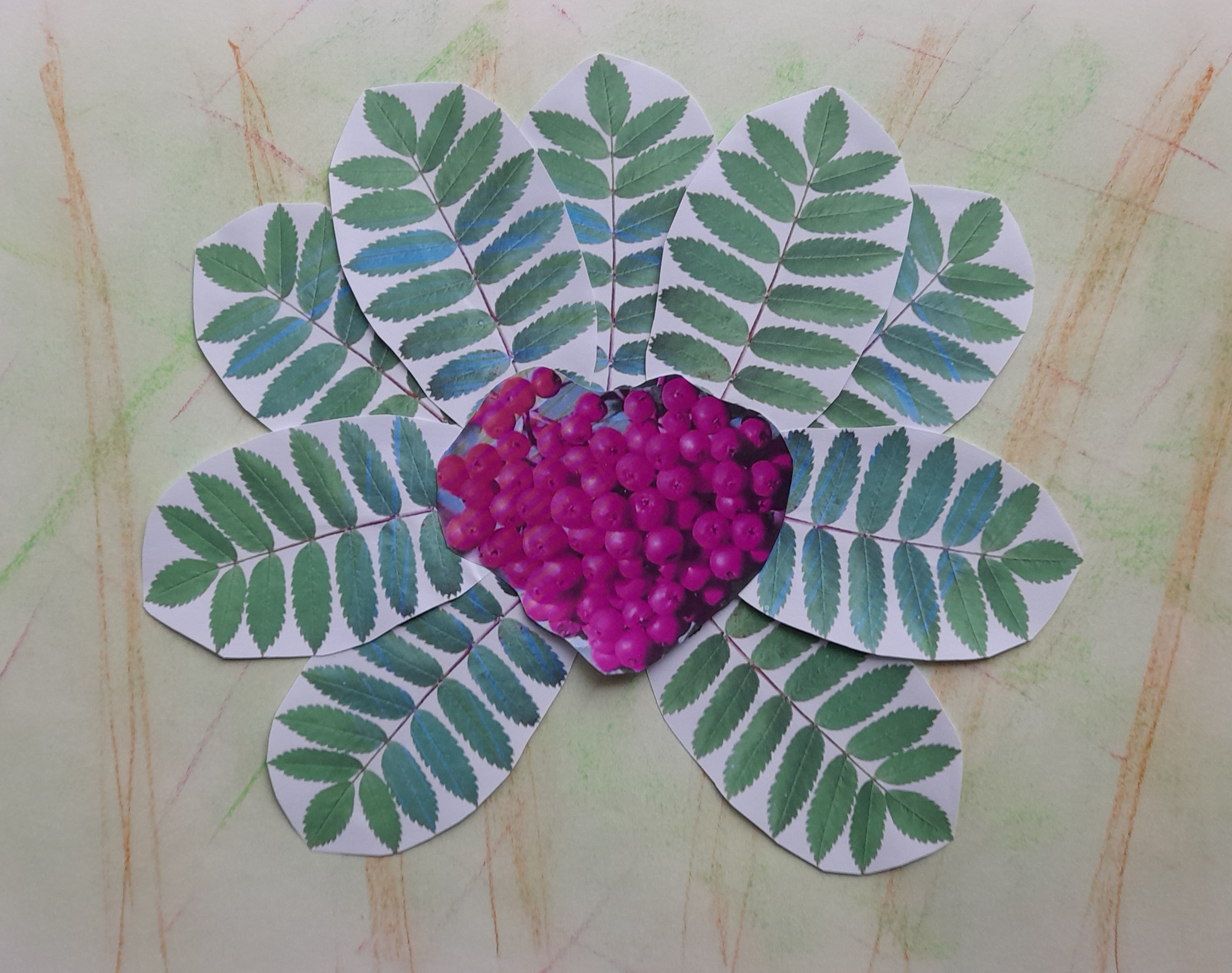
And here is some more of my artwork to honour the lovely Rowan:
Love Rowan
In music I can only recall one song that features the Rowan, it is a traditional Scottish folk song, The Rowan Tree, written by Carolina Oliphont (Lady Nairne) (1766-1845) and it was used in the 2022 movie Living, sung by Lisa Knapp. Here is a link:
If you wish to read the full lyrics of the song, I’ve added a link below [ 3 ]